
What is the Federal Scholarship Tax Credit (FSTC) program?
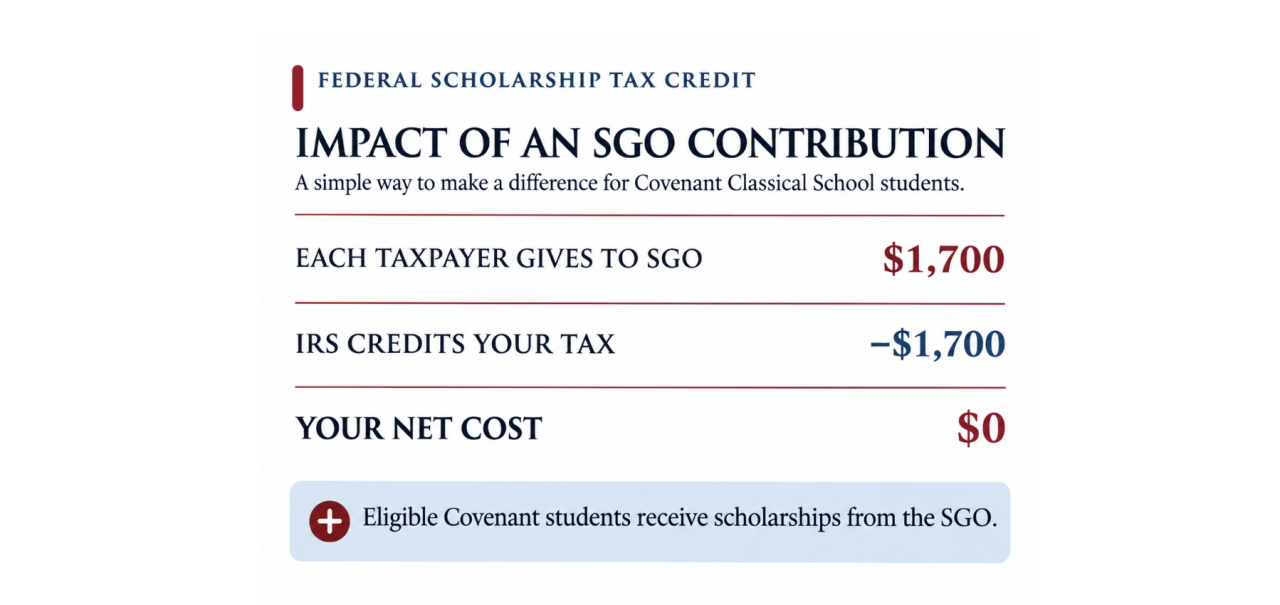
Beginning January 1, 2027, the Federal Scholarship Tax Credit (FSTC) program will allow eligible individuals to receive a federal income tax credit for qualifying contributions to approved Scholarship Granting Organizations (SGOs). The annual tax credit is up to $1,700 per individual, but married couples filing jointly may qualify for a combined credit of up to $3,400. Qualifying contributions must go to an SGO included on a state’s approved SGO list submitted to the IRS for the applicable calendar year.
What is a Scholarship Granting Organization (SGO)?
An SGO is a qualifying tax-exempt 501(c)(3) public charity that receives tax-credit contributions, verifies student eligibility, and awards scholarships for qualifying educational expenses. Federal law requires SGOs to award scholarships to at least 10 students who do not all attend the same school and spend at least 90% of their income on scholarships for eligible students.
How Could This Program Benefit Covenant Families?
An SGO relationship could create additional scholarship opportunities for eligible students attending Covenant. These scholarships could help reduce a family’s tuition burden and make Covenant accessible to more mission-fit families. Covenant is evaluating potential SGO relationships, including how scholarships would be administered, how they would coordinate with other assistance, and whether participation would be consistent with our Christian mission and preserve our institutional independence. Additional information will be shared as decisions are made.
Eligibility & Application Process
Students must be eligible to enroll in a public elementary or secondary school and have a household income during the calendar year preceding the scholarship application that does not exceed 300% of the applicable area’s median gross income. This measure differs from the federal poverty level. Eligible families may apply through a participating SGO once its application process opens. SGOs will verify eligibility and award scholarships. Please note that eligibility does not guarantee funding and that a tax credit amount does not limit the amount that an individual student may receive in scholarships.
Frequently Asked Questions
Q: Is this the same as Texas Education Freedom Accounts (TEFA)?
A: No, FSTC is a separate federal program built around qualifying contributions to SGOs. Families should not assume that approval for one establishes eligibility for the other.
Q: How would scholarships affect TEFA or Covenant’s Tuition Assistance Program?
A: Covenant is evaluating how these funding sources would work together. Families should continue following existing application requirements and should not assume that all awards can be added together.
Q: Can I direct my contribution to support students attending Covenant?
A: We expect that contributors will be able to specify a preferred school at the time of their contribution, and that SGOs will be able to direct scholarship funds accordingly. According to the information available now, contributions cannot be earmarked for any particular student, including a contributor's child.
Q: Will participation affect Covenant’s mission or autonomy?
A: Protecting Covenant’s Christian mission and institutional independence is central to our evaluation. Our review includes applicable requirements and SGO agreements.
Q: Would this replace giving directly to Covenant?
A: No. Scholarship tax-credit contributions serve a different purpose from charitable gifts made directly to Covenant. Tax-credit contributions are restricted for scholarships only and will not appear on Covenant's annual contribution reports or be calculated in tax receipts issued by the school. On the other hand, gifts to Covenant are tax-deductible, support our school’s fundraising goals, and provide resources beyond tuition revenue to strengthen our faculty, programs, facilities, and student experience. We see these as complementary opportunities – one helps families access a Covenant education, while the other sustains and enriches the education we provide. As scholarship opportunities expand, continued generosity to Covenant remains essential.